Why Your Grill Won't Light, and What to Check Before You Call
Most no-light problems come down to a short list of causes, and some are safe to check yourself.
October 20, 2026 · 4 min read
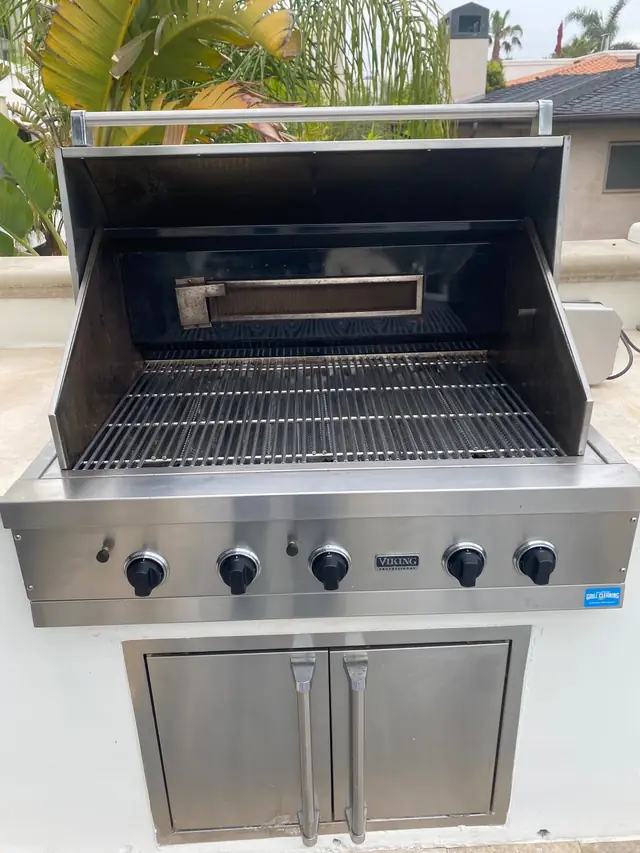
You press the igniter, it clicks, and nothing happens. Or you hear a rush of gas and see no flame at all. Either way, a grill that will not light on a Saturday afternoon is frustrating. Most of the time the cause is one of a short list of things, and a few of them take thirty seconds to rule out.
One rule comes before everything else: gas is not a place for guesses. Check the simple things below, and if the problem involves a gas smell, a hose, a valve, a regulator fitting or a connection, stop and call someone who repairs grills. Never improvise a gas repair.
Start with the basics
- Is there gas? Check the tank level, or confirm the supply valve is open on a natural gas line.
- Are the burner knobs set correctly? Push in and turn to the light position, then hold for a few seconds.
- Is the lid open? Always light a gas grill with the lid open.
- Is the igniter battery fresh? A weak battery gives a weak spark or none.
- Is anything in the way, such as a grate out of place, a drip tray askew or debris sitting on the electrode?
Igniters and electrodes
An igniter has two parts you can look at without touching any gas fitting. The button or knob creates the spark, and a small ceramic electrode near the burner delivers it. If you hear a click, the spark mechanism is probably working. To see the spark itself, try it in dim light with the gas off and look near the electrode. A visible, steady spark is a good sign.
If there is no spark, the usual suspects are a dead battery, a loose or corroded wire, a cracked electrode, or an electrode coated in grease or soot. A dirty electrode can be wiped gently when the grill is cold. The gap between the electrode tip and the burner matters too, because the spark has to jump it. If the electrode has been bumped, bent or worn, the spark may go somewhere else, and that is a repair worth leaving to someone who works on grills.
Spider webs and debris in the burner tubes
This one surprises people. Burner tubes have small openings where air mixes with gas before it reaches the ports. Spiders and other insects like those openings, and webs, nests and debris can block the flow. When that happens, gas has a hard time reaching the burner. Flames come out weak, yellow or only at the front, or the grill will not light at all. In some cases gas backs up and burns near the knobs, which is dangerous.
Grills that sit unused for a while, or sit out in a backyard between seasons, are good candidates. If your grill has been quiet since last summer and now will not light, a blocked tube is one of the first things worth suspecting.
Clogged ports and orifices
At the end of each gas line sits a small fitting called an orifice, with a precisely sized hole that meters the gas. Grease, rust flakes and corrosion can narrow that hole. The ports along the burner can also fill up with burned-on residue. Either problem starves the flame. A grill with clogged ports lights unevenly, burns weakly along part of the burner, or flares in the wrong places.
Orifices and gas fittings are not a do-it-yourself item. They need the right tools and a clear understanding of what is safe, and the price of a mistake is a gas leak.
Regulator bypass mode
Many modern propane regulators include a safety feature that limits gas flow if it senses a sudden surge, such as when the tank valve is opened too fast. When that feature trips, the grill may light with a tiny flame, or not at all, even though the tank is full. Owners often describe it as the grill running on low, or the regulator being in bypass.
Most grill manuals describe a reset. The usual idea is to turn every burner knob off, close the tank valve, wait a minute, then open the tank valve slowly and relight. Steps vary by brand, so follow your own manual exactly. If a reset does not help, or if you do not have the manual, the next step is a phone call, not a wrench.
If you smell gas
If you smell gas at any point, turn off the burner knobs, close the tank valve or the supply, keep the lid open, move people away and keep flames and sparks away from the grill. Do not keep clicking the igniter. Do not hunt for the leak by trial and error. Let the area clear, and have the grill inspected by someone qualified before you use it again.
What a repair visit looks like
We repair grills at your home, so there is no hauling a heavy grill anywhere. Repair work starts with a $150 service call that has a one-hour minimum, and time after that is $150 an hour. During a deep cleaning we inspect igniters, burners, gas line and tubes, valves, orifices, regulators and the thermometer, and we repair working parts that are not functioning because of dirt or assembly problems. That is why a grill that will not light is a natural fit for a visit.
If a part has failed, we can get the parts that are right for your grill. South Bay Grill Cleaning repairs and cleans grills at your home across the South Bay. If your grill will not light, call (310) 994-8408.
South Bay Grill Cleaning, (310) 994-8408
Call (310) 994-8408More articles
Overheating Your Grill: Why It Runs Hot and Flares Up
When the lid thermometer and the knobs stop agreeing, the grill under them has usually changed.
How to Measure Your Grill Before You Book a Cleaning
A tape measure and two minutes will tell you which size band your grill falls into.