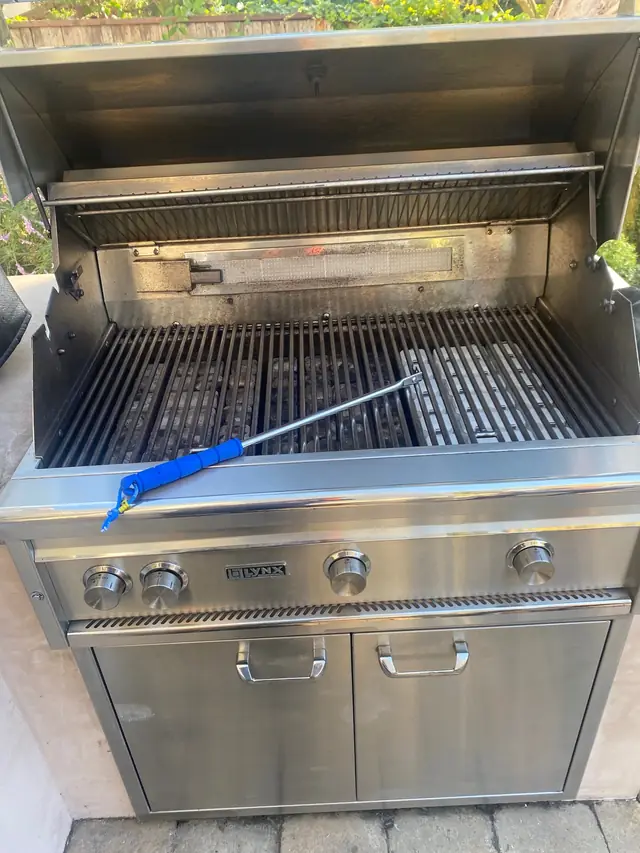
What grease and heat do to a grill left alone
A grill does not fail all at once. Grease bakes onto the flavorizer bars and heat plates, drips into the firebox, and slowly fills the burner ports. The first sign is usually uneven heat, one side of the grates running hotter than the other. The next is flare-ups, because old grease burns when the flame reaches it. In a firebox that has never been scraped out, that grease is also what turns a flare-up into a grease fire.
Dirt also causes problems that look like broken parts. A dirty igniter will not spark cleanly, a burner with packed ports burns weak and yellow, and surface rust blooms wherever moisture sits under old residue. Plenty of South Bay grills near the coast arrive with all three at once. A good share of those problems are dirt or assembly problems rather than dead parts, and a deep clean fixes them without a replacement.
How the teardown goes, part by part
The crew arrives at your home or business, lays out tarps first, and takes the grill apart. Grill grates, racks, flavorizer bars and heat plates or briquettes come out and get deep cleaned. The firebox is degreased and vacuumed. The drip pan and grease tray, the underside of the hood and all the internal walls get the same treatment, and the burners are cleaned while they are out where they can be seen.
The outside gets its turn last. Exterior, knobs and handles are deep cleaned and polished, and surface rust is removed. A Napoleon owner wrote that the stainless was polished at the end and the grill looked brand new. Everything is done with non-caustic, non-toxic, biodegradable products, with no harmful odors or fumes.
A full deep clean takes a few hours. The goal, in the company's own words, is to restore your grill as close to its original condition as possible.
Inspection, repairs on the spot, and when to book again
With the grill open, the crew inspects the igniters, burners, gas line and tubes, valves, orifice, regulators and thermometer. Any working part that stopped because of dirt or an assembly problem gets repaired during the visit. If a part is truly worn out, the grill repair page explains how replacement parts are sourced for your model.
A 24 to 28 inch grill starts at $345, and the price steps up with the width of the grilling surface. Full cleaning after a rodent infestation is a $75 add-on. How soon you need it again depends on how often you cook. One Lynx owner, who had cleaned her grill herself for years, wrote that after the first visit it looked brand new and that she has used the crew for ongoing maintenance ever since. To book, call (310) 994-8408.